
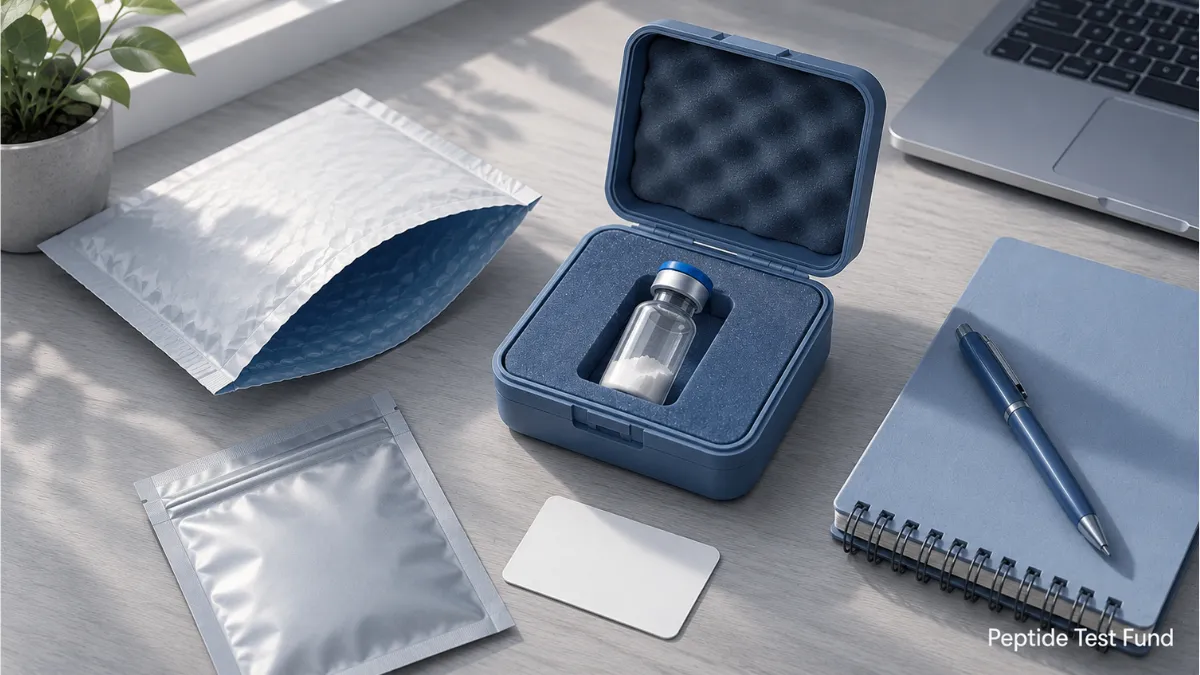

The only reliable way to know how much peptide is actually in a vial is to measure it with an appropriate quantitative laboratory assay. The label tells you what the vial is supposed to contain, but the amount of visible powder and even a high purity percentage cannot confirm the actual milligrams present.
If you’re trying to determine how much peptide is really in a vial, it helps to separate four different things: the labeled amount, the visible material, purity, and measured quantity. They may sound related, but they do not answer the same question.
| What You’re Looking At | What It Actually Tells You |
|---|---|
| Vial label | The amount the product claims to contain. |
| Visible powder | What the dried material looks like, not its measured peptide content. |
| Purity percentage | The relative purity measured by a particular analytical method. |
| Quantitative assay | A laboratory measurement used to determine how much of the target peptide is present. |
| Identity test | Evidence about whether the material is consistent with the intended peptide. |
The Takeaway: If the question is how many milligrams are actually in the vial, you need a test designed to measure quantity.
Key Point: A vial can look full, test highly pure, and still contain a different amount of peptide than its label claims.
On This Page
- Does the Label Tell You How Much Peptide Is Actually in the Vial?
- Can You Tell Peptide Quantity by Looking at the Powder?
- Does 99% Purity Mean the Vial Contains the Right Amount?
- How Do Laboratories Measure Peptide Quantity?
- What Does a Peptide Quantity Result Tell You?
- Does One Quantity Test Represent Every Vial?
- The Bottom Line
- Frequently Asked Questions
Does the Label Tell You How Much Peptide Is Actually in the Vial?
The label tells you the claimed amount, not the independently measured amount. A vial marked 10 mg is making a statement about what the vial is intended or represented to contain.
To establish how much peptide is actually present, the contents have to be measured. This distinction is familiar in pharmaceutical quality testing, where the U.S. Food and Drug Administration treats an assay for content or strength as a specific analytical test rather than something inferred from appearance or labeling.
A label can therefore be accurate, high, or low relative to an independent measurement. Without testing, you simply do not have that measurement to compare against the claim.
Can You Tell Peptide Quantity by Looking at the Powder?
No. The visible size of the lyophilized material is not a reliable measurement of peptide quantity. A few milligrams occupy very little physical space, and the dried material may appear as a puck, thin film, dusting, flakes, or residue along the glass.
As we explain in Why Does My Peptide Vial Look Empty?, formulation ingredients and freeze-drying conditions can also influence the appearance of the dried material. Two vials can therefore look different without that difference telling you how much peptide each contains.
Even weighing the entire sealed vial on an ordinary scale would not solve the problem. You would be weighing the glass, stopper, cap, peptide, and any other material together. A laboratory quantity test is designed to measure the target analyte rather than simply the gross weight of the vial.
Does 99% Purity Mean the Vial Contains the Right Amount?
No. A purity percentage does not tell you whether the vial contains the labeled number of milligrams. Purity and quantity are separate analytical measurements.
Our guide to what 99% peptide purity actually means explains this distinction in detail. A chromatographic purity result describes the relative amount of the main detected component compared with other detected components under that test method.
So if two samples both report 99% purity, one could still contain more peptide than the other. The purity result alone cannot tell you how much peptide was present in either vial.
| Question | What You Need |
|---|---|
| Is this the intended peptide? | Appropriate identity testing |
| How pure is the sample? | An appropriate purity analysis |
| How many milligrams are present? | A quantitative content assay |
| Is the sample sterile? | A separate sterility test |
Key Point: Do not use a purity percentage as a substitute for a quantity result. They answer different questions.
How Do Laboratories Measure Peptide Quantity?
A laboratory measures peptide quantity using a quantitative analytical procedure designed for that specific purpose. In laboratory terminology, this type of measurement is often called an assay or content determination.
The exact method can vary depending on the peptide, sample, laboratory, and purpose of the analysis. Some quantitative procedures use chromatography with appropriate standards or other validated analytical approaches. What matters is that the procedure is capable of measuring the target analyte with suitable accuracy, precision, specificity, and range.
FDA’s current Q2(R2) guidance on analytical procedure validation describes the framework laboratories use to establish that quantitative methods are fit for their intended purpose.
That is fundamentally different from looking at a vial and estimating how much peptide appears to be inside.
What Does a Peptide Quantity Result Tell You?
A quantitative result can tell you how much of the target peptide the laboratory measured in the submitted sample. That result can then be compared with the vial’s labeled or claimed amount.
For example, if a vial is represented as containing a particular number of milligrams, a suitable quantitative test can provide evidence about whether the measured content is close to, above, or below that claim.
When reviewing a quantity result, look for context such as:
- The claimed amount: What did the vial say it contained?
- The measured amount: What quantity did the laboratory report?
- The analytical method: Was the test designed to measure peptide content?
- The sample tested: Which specific vial, lot, or submitted sample does the result represent?
- Other testing: Were identity, purity, or other quality questions evaluated separately?
Looking at these pieces together gives you a much more useful picture than asking only how much peptide the vial appears to contain.
Does One Quantity Test Represent Every Vial?
No. A laboratory result directly describes the sample that was actually tested. It should not automatically be treated as proof that every vial from the same vendor, product, or even batch contains an identical amount.
Manufacturing consistency and sampling are separate questions. Testing additional samples can provide more information, but a single result still has a defined scope.
This is one reason Peptide Test Fund publishes independent laboratory results through a community-funded testing model. You can learn more about the process on the How It Works page and about the types of analytical questions on our Testing Standards page.
The goal is not to turn one vial into a verdict on an entire vendor. It is to provide objective evidence about how much peptide was measured in the sample that went to the laboratory.
The Bottom Line
If you want to know how much peptide is actually in a vial, the answer comes from quantitative laboratory testing. The label tells you the claimed quantity, while the powder’s appearance tells you very little about actual peptide content.
Purity cannot answer the question either. A vial can have high purity and still contain more or less peptide than the label claims.
To know how much peptide was present in a particular sample, look for an independent quantity or content result produced by an appropriate analytical method.
Frequently Asked Questions
Can you tell how much peptide is in a vial just by looking at it?
No. The visible amount of lyophilized material is not a reliable measurement of peptide content. A quantitative laboratory test is needed to determine the amount present.
Does 99% peptide purity mean the vial contains the labeled milligrams?
No. Purity describes the relative composition detected by the purity method, while quantity measures the actual amount of peptide present.
What test tells you how much peptide is in a vial?
A quantitative assay or content determination is used to measure how much peptide is present. The specific analytical method can vary depending on the peptide and laboratory.
Can an underfilled peptide vial still test at high purity?
Yes. A sample can have high purity while containing less peptide than the labeled quantity because purity and quantity are separate measurements.
Does one peptide quantity test prove every vial has the same amount?
No. A laboratory result directly represents the submitted sample. One tested vial does not establish that every other vial, batch, or vendor product contains the same quantity.